 Yoga Podclass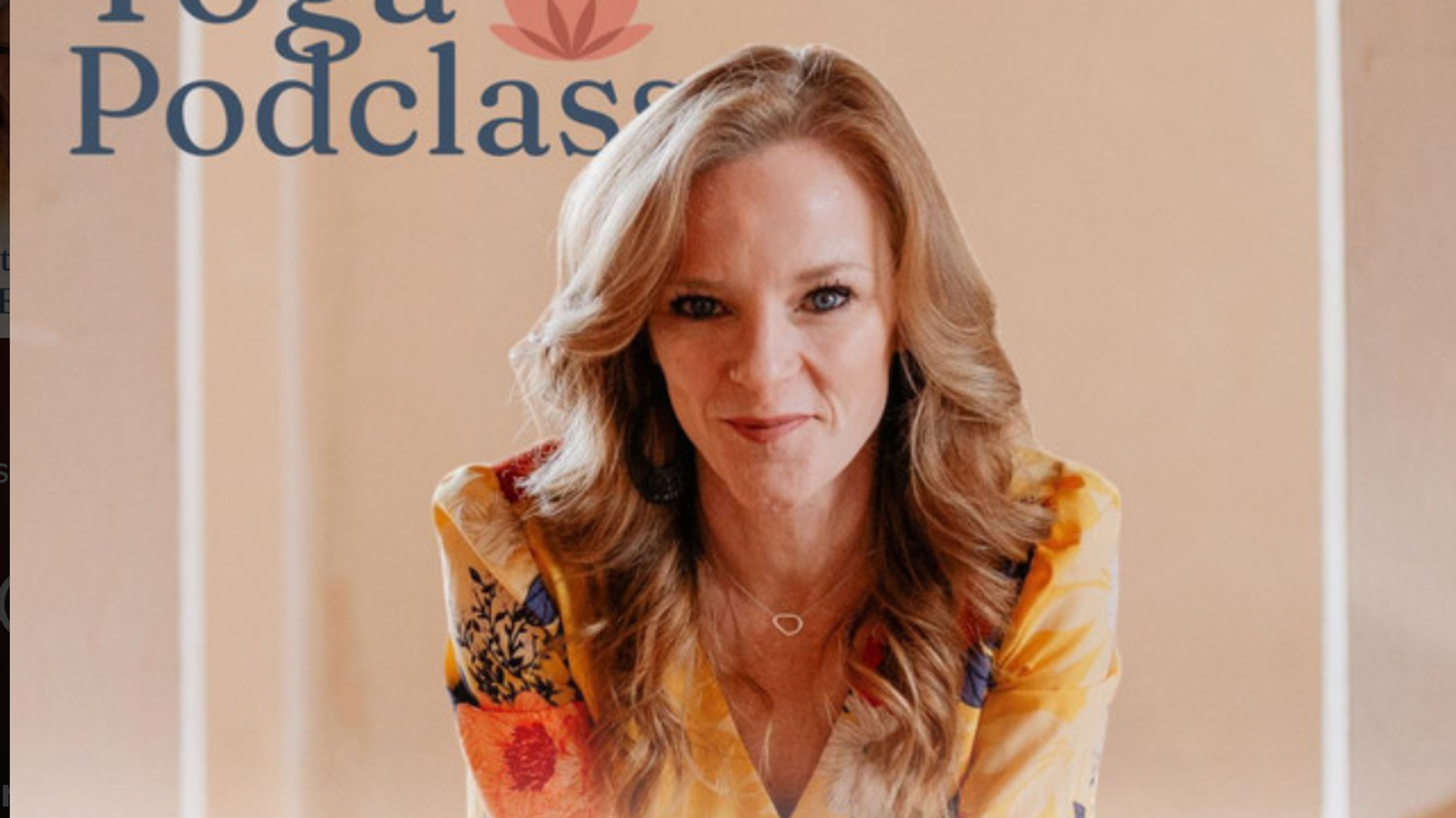
I tried to win yoga for years.
Not consciously. Nobody walks into a studio thinking "I'm going to dominate tree pose." But I showed up with the same wiring I brought to everything else: perform, earn approval, get the gold star. And honestly, I think a lot of us do that. We bring the patterns we've built in every other part of our lives straight onto the mat, and then we wonder why savasana feels like the hardest pose in the room.
That's what made our conversation with Ellie Roscher hit so differently. Ellie is an author, yoga teacher, and someone who thinks about the relationship between our bodies and our stories with more precision and honesty than almost anyone I've encountered. She didn't just talk about body awareness in the abstract. She made it specific. Tangible. And at times, uncomfortably real.
The stories that aren't yours
Here's a concept Ellie introduced that I keep coming back to: master narratives. She's drawing from Hildy Linderman Nelson's work on narrative repair, and the premise is straightforward. Society hands us stories about our bodies. Some of those stories are limiting. Some are harmful. And some are so deeply embedded that we don't even recognize them as stories anymore. We just think they're true.
Ellie named a few of hers. As a woman, the story that her body is inferior. That her body will depreciate with age. And here's the part that stuck with me: she asked who benefits when we believe those stories. The beauty industry profits from the lie that aging makes us less valuable. The workplace benefits from bodies that stay quiet and compliant. These stories aren't accidental. They're doing work.
And then she said something that reframed my entire understanding of what practice can be: the yoga mat is a place where your body can talk back to those stories.
Not through affirmations. Not through positive thinking. Through the actual physical experience of proving a false narrative wrong in your own body.
The elbow, the wheezing, and decades of breathing backwards
Ellie broke her elbow as a 10-year-old gymnast. She competed with a permanently bent arm from age 10 through 22. The story she told herself at the time was simple: it happened, she recovered, she moved on.
Except her body told a different version.
After the injury, the tumbling pass that caused the break was still in her floor routine. And as she'd approach that pass in practice, she started wheezing. Her body was terrified. It was bracing for impact. It was trying to tell her something.
She got sent to a doctor who called her a "psychosomatic hyperventilator." She was 13. She didn't know what that meant. It sounded to her like she was being dramatic. So she stopped wheezing.
But the fear didn't stop. It just went underground. Decades later, a yoga therapist pointed out that Ellie was a paradoxical breather. On her inhale, she was sucking in instead of expanding. She'd been breathing backwards for most of her adult life. The tight jaw, the neck problems, the tension she carried in her upper chest. All of it traced back to a body that was scared and a 13-year-old who learned to override it.
When Ellie told this part of the story, I felt it in my own body. How many of us have done some version of this? Not necessarily with gymnastics or a broken bone, but with the subtler injuries. The moments where our bodies said something was wrong and we decided the response was inconvenient or embarrassing or unproductive, so we shut it down.
Your body is not the problem
One of the most powerful moments in this conversation came when Ellie described working with a man named Sam, a veteran with a prosthetic leg who had been attending yoga classes for years. He'd built his entire practice around fitting into existing sequences. He'd figured out when to put the prosthetic on, when to take it off, how to work around a system that wasn't designed for his body.
When Ellie invited him to co-design his ideal yoga class, he couldn't do it. He was so conditioned to adapting to the system that the idea of the system adapting to him was almost incomprehensible.
And then Ellie said the thing that cracked everything open: "Sam, your body's not the problem. The lack of imagination in the sequence is the problem."
That's a sentence I think about now every time I'm in a room where someone is struggling to fit into a structure that wasn't built for them. At work. In relationships. In the stories we tell about what our bodies should look like, should be capable of, should tolerate without complaint.
What this has to do with the rest of your life
This is the part that Ellie brought into territory I wasn't expecting. She talked about how workplaces systematically invite us to be disembodied. How the legacy of productivity-over-people culture means we leave our body wisdom at the door when we clock in. How the hierarchy of minds over bodies has deep roots in gender and race. How dreaming and collaborating happen in diaphragmatic breathing, not in fight-or-flight. And how the person in a meeting who pauses and says "something feels off" gets dismissed as woo-woo instead of being recognized as someone whose body is picking up information that the spreadsheet can't capture.
She shared that she once had a job where she was actively miscarrying at her desk and didn't feel like she could tell anyone. Think about what that costs. Not just the person going through it, but the team, the culture, the decisions being made by a group of people who've all agreed to pretend they don't have bodies.
The cue
At the end of every Off the Mat episode, we close with a cue. Something to carry with you. Ellie's was built on a quote she loves: "Home is the place where all your attempts to escape cease."
Her cue: Follow this exhale back home to your body. Back home to this moment, where there is so much to notice.
That's the invitation. Not to fix anything. Not to achieve some new level of body awareness. Just to stop trying to escape the body you're already in. To notice that it's been talking this whole time. And to consider what might change if you actually listened.
This conversation is from our Off the Mat episode with Ellie Roscher. You can listen to the full episode on Spotify or Apple Podcasts. Ellie teaches at Up Yoga in South Minneapolis and is the author of six books, including The Embodied Path, 12 Tiny Things, and her most recent, Fair Game. Find her at ellieroscher.com or on Instagram @ellierocher.