 Yoga Podclass
Coming Back: Nervous System Regulation On and Off the Mat
You finished the hard conversation. You closed the laptop. You told yourself you were done for the day. But twenty minutes later you’re still replaying it, jaw tight, shoulders somewhere near your ears, waiting for the next thing to go wrong. You’re not being dramatic. Your nervous system is still running the threat response — and nobody taught you how to turn it off.
In This Article
- •What nervous system regulation actually is — not calm as a goal, but the ability to return
- •How to work with activation on the mat — specific poses and what your body is doing physiologically
- •Where the same patterns appear off the mat — work, relationships, 2am, the grocery store
- •Language for making the connection — exact phrases that bridge physical practice to daily life
Introduction
Nervous system regulation isn’t about being calm. That’s the misconception worth clearing up first. Your nervous system is designed to activate — to respond to threat, to stress, to the demands of living. That’s not the problem. The problem is that most of us have lost the pathway back down.
You have two main branches doing this work. The sympathetic nervous system is your gas pedal: fight, flight, mobilization. The parasympathetic is your brake: rest, digest, return. Most of us are driving with the gas pedal pressed to the floor, even when there’s nowhere to go.
The vagus nerve — the longest nerve in your body, running from your brainstem through your face, throat, heart, lungs, and gut — is your master regulator. Here’s what matters: it’s trainable. Every time you slow down, ground into your body, and extend your exhale, you’re strengthening the neural pathways back to calm. This isn’t just relaxation. It’s capacity-building.
What it’s not: a cure-all. A yoga class won’t fix collective fear or systemic stress. It won’t replace human connection, professional support, or political action. It’s one tool — a meaningful one — among many.
On the Mat
The mat is a useful place to study dysregulation because the poses create conditions where it becomes visible. You're not in a meeting. Nobody's watching. Nothing is actually at stake. And yet the same patterns show up anyway — which tells you something important about where they actually live.
Breath holding in transitions — moving from pose to pose without a full breath in between. The body is doing yoga but the nervous system never got the signal to downshift.
Jaw clenching — tension in the face during poses that have nothing to do with the face. Pigeon is the most common place to catch it, but it shows up anywhere the body is asked to wait.
Grip beyond what the pose requires — hands pressing harder into the mat than necessary, toes gripping, shoulders creeping toward the ears in a forward fold. Holding tension in places nothing is asking for it.
Rushing through stillness — restlessness in holds, the urge to move before the cue comes, Savasana feeling like an obstacle rather than the point. The system is still running even when the body has stopped.
ose selection rationale: These poses work because they each carry a physiological mechanism — not just a metaphor. Supine positions lower blood pressure and send calming signals to the brainstem. Psoas stretches access the body’s primary stress muscle. Inversions (Downward Dog, Forward Fold) shift blood flow and trigger the vagal brake. Teach the mechanism, not just the shape.
Key cueing language:
- “Notice where you’re gripping when nothing is asking you to.”
- “The exhale is your brake. Every exhale, a return.”
- “The hip doesn’t open on your schedule. It opens when you trust it to.”
- “Soften the jaw. The jaw and the hips are connected.”
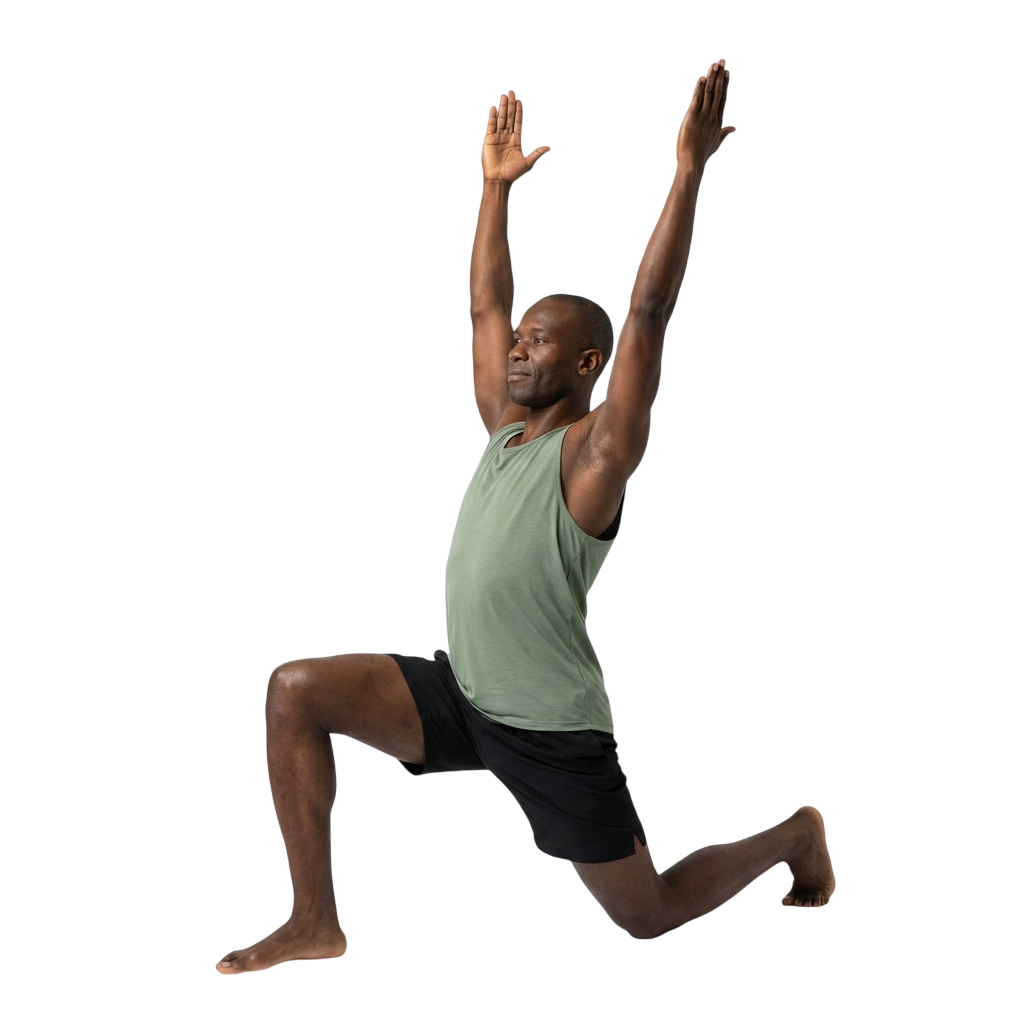
Sequencing note: Move through activation (standing sequence, lunges) before the floor work. Students need to experience the gas pedal before they can meaningfully practice the brake. Savasana isn’t the only regulation practice — the whole arc is.
Common obstacle: Students will rush through the floor poses to get to Savasana, treating the shapes as obstacles rather than the practice itself. If you notice people moving quickly in Supine Pigeon, name it: “If you’re already thinking about what comes next, that’s the pattern we’re working with.”
Off the Mat
The same nervous system running your yoga practice is running your Tuesday. The signals are different — no mat, no Pigeon pose — but the pattern is identical.
At work: You're in a meeting that goes sideways. Someone pushes back, the project stalls, you say something you immediately wish you'd said differently. The meeting ends. You close your laptop and move to the next task. But you're not actually there yet — you're still in the room, still in the argument, still gripping. You get three more things done on autopilot and don't notice until 4pm that you've been holding your breath since noon.
In conversations: A friend is upset and telling you about it. Somewhere in the second sentence you stopped listening. You're not present — you're planning your response, managing where the conversation is going, preparing for what they might need you to say. It's not unkindness. It's a nervous system that learned to stay one step ahead. The cost is that you never actually receive what's being said.
At rest: You sit down to do nothing and last about ninety seconds before reaching for your phone. Or you lie in bed and the thoughts that couldn't reach you during the day find you now — the to-do list, the thing you should have said, the background worry you've been outrunning since morning. Stillness feels unsafe. Not dramatically. Just slightly more uncomfortable than staying busy.
What makes this hard: staying activated works, or at least it used to. It keeps you sharp, ready, ahead of the next thing. Coming down feels like risk — like you might miss something, or fall behind, or have to feel whatever you've been moving fast enough to avoid. The pattern persists not because you're broken but because it was useful once. Recognizing it doesn't mean you have to dismantle it immediately. It means you can start to notice when it's costing more than it's giving.
Pick one or two of these scenarios based on what you know about your students. Specificity is what makes the off-mat content land — "still in the meeting after it ended" will hit differently than any abstract concept about stress. You're not explaining the pattern to them. You're holding up a mirror.
Introduce off-mat material during transitions — setting up Savasana, moving from standing to the floor. Students are more receptive when the body is already slowing down. Avoid inserting it mid-effort when they're managing physical demand.
Keep it an invitation: "If you notice this week that you've left a situation but your body hasn't..." Not a diagnosis. Not a homework assignment. A seed.
Making the Connection
Connecting your experience on the mat to your life off the mat.
"The practice isn't about being calm. It's about knowing the way back. Your nervous system is designed to activate — that's not the problem. The practice is building the pathway home for when activation has taken you somewhere you didn't choose to go."
"When you notice you're still in the room after you've left it — still in the conversation, still in the meeting, still in the moment that ended an hour ago — that's the same pattern as gripping in a pose that isn't asking for it. The body knows what to do. Feet on the floor. One slow exhale. The felt sense of something solid underneath you. That's the practice. That's what you take with you."
Deliver bridge language at the end of class — during Savasana setup or the final seated position, after the physical work is done. State it once and let it land. Don't repeat it or explain it. Students will take what's relevant for them.
One phrase per class is enough. More becomes lecture.
Try This
This week, notice when you've left a situation but your nervous system hasn't. The meeting that ended an hour ago. The conversation you're still rehearsing. The task you finished but can't put down.
When you catch it, try this: feet on the floor, one extended exhale, the felt sense of whatever surface is underneath you. You don't need a mat. You don't need five minutes. You need thirty seconds and the willingness to interrupt autopilot.
You might not notice anything the first time. That's fine. The noticing is the practice — not the outcome.
Offer this as availability, not assignment: "If you're curious this week, try catching the moment when you've left a situation but your body hasn't." Most students won't do a formal practice. The invitation is still useful. It plants the frame, and the frame is what makes the noticing possible.
Where are you noticing the gap this week — between where you are and where your nervous system still thinks you are?
Related Episode