 Yoga Podclass
The Pause: On and Off the Mat
You're mid-conversation when you realize you stopped listening three sentences ago. You're planning your response, waiting for your turn to speak, already gripping where the conversation should go next. You skipped the pause—that brief space where you could have actually received what was being said.
In This Article
- •Understanding the Power of Pause — Discover what pausing can do for you in yoga and life.
- •Applying the Pause in Yoga Practice — Learn about specific poses and breath work that embody the concept of pausing.
- •Translating Pauses to Daily Life — Gain insights on how to incorporate intentional pauses into your everyday routine for better decision-making and presence.
- •For Teachers — Enhance your teaching with pause-focused sequences and cues that deepen your students' practice and life experience.
Introduction
The pause is the space between stimulus and response—the moment where you could choose differently, if you noticed it was there. Most of us move through our days on autopilot, one thing flowing immediately into the next without conscious transition. The pause disrupts that momentum.
The pause is the space between stimulus and response—the moment where you could choose differently, if you noticed it was there. Most of us move through our days on autopilot, one thing flowing immediately into the next without conscious transition. The pause disrupts that momentum.
This isn't about meditating for twenty minutes or "being present" in some abstract way. It's simpler: can you create a brief gap between what just happened and what you do next? On the mat, that might be the breath you take before moving into a pose. Off the mat, it might be the three seconds you wait before responding to a text that annoyed you.
The pause doesn't need to be dramatic. It just needs to interrupt the automaticity. When you pause, you create the possibility—not the guarantee, but the possibility—of responding from awareness rather than habit.
What the pause is NOT: forced stillness, spiritual bypassing ("just breathe through your anger"), or another thing you're supposed to perfect.
On the Mat
Transitions reveal everything about your relationship with pausing. The space between poses—how you move from downward dog to forward fold, from standing to the floor—shows you whether you're rushing through moments or actually inhabiting them.
Forward folds offer natural pause points. In uttanasana (standing forward fold), there's the moment after you fold and before you decide what to do with your arms, your head, your breath. Can you let that moment exist? Or do you immediately fill it—adjusting, fidgeting, moving to the next thing?
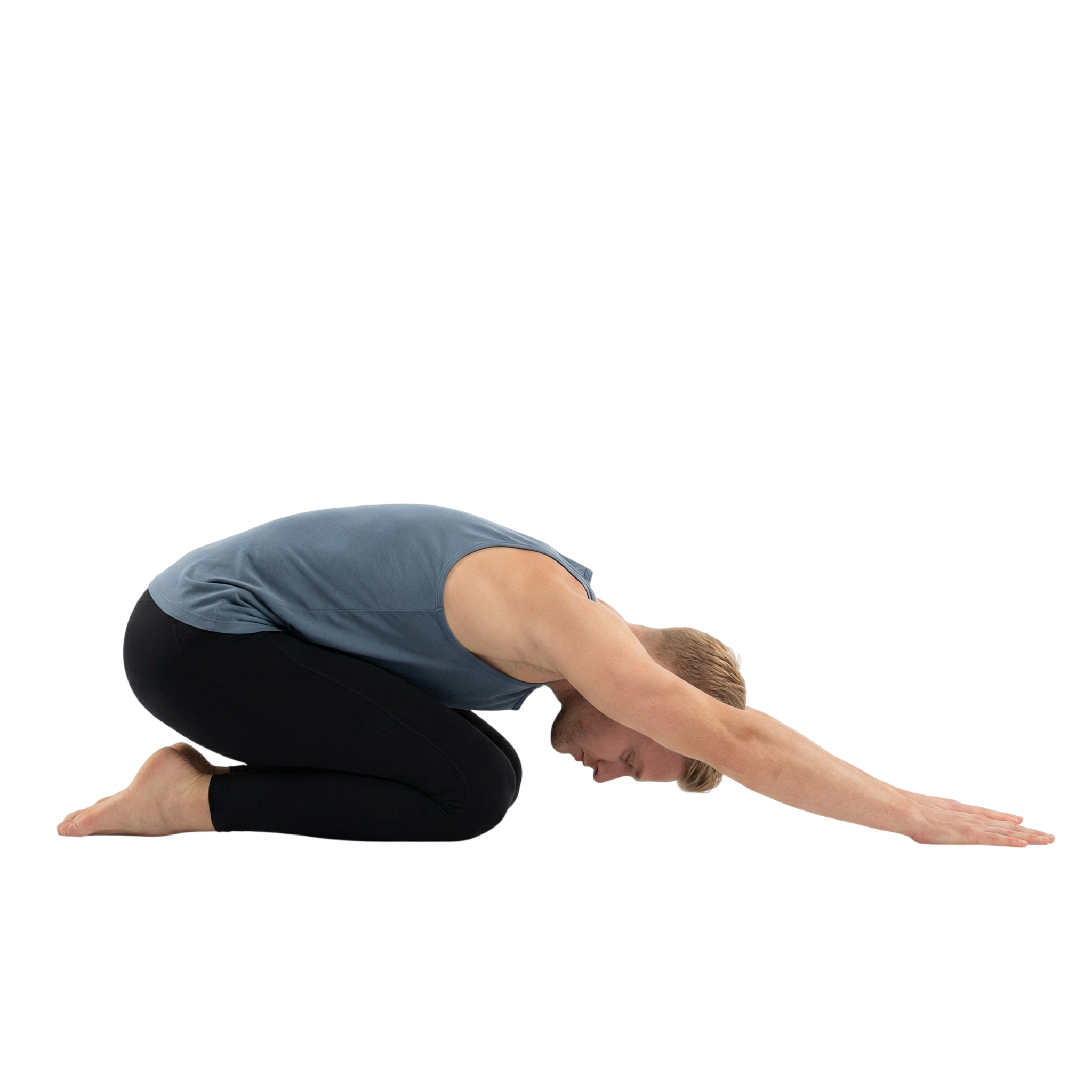
Child's pose is designed as a pause, yet many people make it another task. They arrive already planning their exit. The pause here is simple: can you arrive fully before you start preparing to leave?
Savasana is the most obvious pause in any class, and the one most people skip internally even while their body stays on the mat. Notice if you're already mentally packing up, planning your afternoon, rehearsing conversations.
What to notice: The quality of your breath during transitions—is it held, choppy, rushed? The moment right after you land in a pose—do you immediately adjust, or can you receive what just happened? When your mind jumps ahead to the next pose while your body is still in this one.
Pose selection: Transitions (any), forward folds (uttanasana), child's pose, savasana. These work because they have clear arrival points—moments where you can explicitly name "we've landed, now pause."
Key cueing language:
- "Move into downward dog. Arrive. Take one full breath here before we move."
- "Notice if you're already leaving before you've fully arrived."
- "The transition is the practice—not the poses themselves."
Sequencing approach: Instead of continuous flow, create deliberate pause points every 3-5 poses. After students land in downward dog or warrior II, hold them there for 2-3 breaths before the next cue. The silence teaches as much as the words.
Common obstacle: Students often interpret "pause" as "freeze." Clarify early: "Pausing doesn't mean holding perfectly still. You can adjust, breathe, shift. The pause is internal—noticing the space, not forcing rigidity."
Your demonstration matters: When you physically demonstrate transitions, slow down visibly. Your pacing teaches pause more effectively than verbal cues alone.

Off the Mat
The same pattern that shows up in transitions shows up everywhere: moving from one thing to the next without space in between.
In conversations: You stop listening halfway through because you're composing your response. The pause would be the two seconds after they finish speaking where you actually consider what they said before talking.
After work: You close your laptop and immediately open your phone, scroll Instagram, start dinner—anything to fill the space between "work" and "evening." The pause would be thirty seconds where you sit with the transition itself.
In conflict: Someone criticizes you and you defend immediately—before you've registered what they said, before you've felt the sting, before you've considered if there's truth in it. The pause would be receiving the impact before responding to it.
With discomfort: You feel anxious and immediately reach for your phone, food, busyness. The pause is noticing "I'm reaching for distraction" before you do it. Not stopping yourself necessarily—just noticing the gap.
Between tasks: You finish one email and immediately open the next one. The pause would be the breath between closing one thing and opening another—the micro-moment where you're between, not already in the next thing.
What makes this hard: Pausing feels unproductive, like wasted time. We're conditioned to fill every gap. The pause asks you to do nothing, even briefly, and that feels counterintuitive.
Sharing examples: Pick 1-2 scenarios that match your students' lives. If you teach corporate clients, use the work/email examples. If you teach parents, reference the transition between work and family. The specificity makes abstract concepts tangible.
When to introduce this: Near the end of class during savasana setup or final seated position—when students are more receptive and less focused on physical effort.
Keep it invitational: "If you notice this week..." not "You should practice..." Frame it as curiosity, not homework. You're planting seeds, not assigning tasks.
What to avoid: Don't lecture. Don't explain the psychology of pausing. Offer one brief example and move on. Let students make their own connections.
Making the Connection
Connecting your experience on the mat to your life off the mat.
"Notice the quality of your transitions—how you move from one pose to the next. Are you rushing through the in-between spaces? That's information. Sometimes off the mat we do the same thing: closing one conversation and immediately opening our phone, finishing one task and jumping to the next. The practice isn't fixing that. It's noticing the pattern so you have a choice."
"Right now, between this pose and the next one, there's a gap. Most of us skip right past it. See if you can catch yourself doing that—on the mat first, then maybe later today in a transition between work and home. Just notice when you skip the space where the pause could live."
When to deliver: During an actual pause—between poses, after everyone settles into child's pose—so the language and experience line up. Right before savasana works well.
How to deliver: Simple, clear, no dramatic tone shifts. State it once and let it land. Don't repeat, don't explain, don't ask students to reflect aloud. The power is in planting the seed, not ensuring it grows immediately.
Keep it short: One bridge phrase per class is enough. More than that becomes lecture.
Try This
Whether you're exploring this on your own or inviting students to work with it, here's a simple off-mat experiment:
This week, notice one transition where you skip the pause. Maybe it's closing your laptop and immediately grabbing your phone. Maybe it's getting criticism and defending before you've processed it.
You're not trying to insert a pause (though you can if you want). You're just noticing: where do I rush through the in-between space?
That's the whole practice. Noticing. You might catch it while it's happening, or ten minutes later when you realize "I did it again." Both count.
If you're teaching: Offer this as optional: "If you're curious, notice one transition this week where you skip the pause." Some students will try it, most won't, and that's fine. The invitation itself plants the seed.
